The Filipino Unbanked
August 11, 2025
After a 17-year career in journalism with ABS-CBN, including stints leading the ANC live coverage of the PSE, executive producing and anchoring ANC’s Business Nightly, and contributing to the award-winning ABS-CBN Data Analytics Team, I retired and joined China Bank Savings, the retail banking arm of Chinabank. At CBS I would get to travel the Philippines conducting financial wellness seminars for teachers, students, employees, and others. It was the perfect way for me to marry my personal advocacy as a Registered Financial Planner, and my new professional career in banking.
That was in 2023. Fast forward to today, I have now personally conducted dozens of financial wellness seminars with thousands of participants across the Philippines over the last two years covering personal financial topics like saving, budgeting, debt management, financial goal setting, and personal finance tools such as the SALN and Cashflow Statement. It has been amazing. It has also been eye opening.
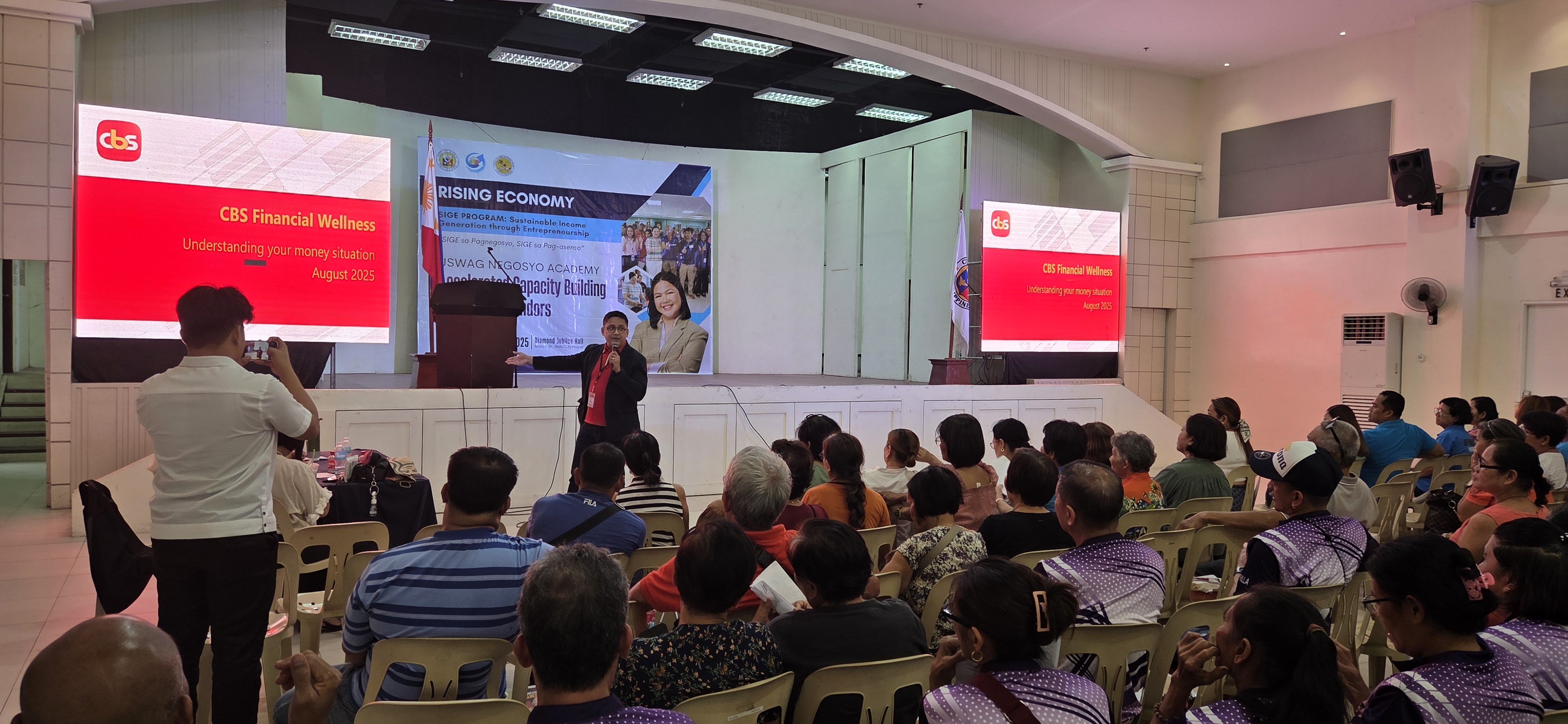 Now I have always been exposed to the Filipino on the street, regularly centering my business reports on real-world implications and first-person accounts. (Yes, your friendly neighborhood ‘palengke’ people follow inflation) But in the world of business and investment news, especially for a Metro Manila-based journalist, it is easy to forget just how many Filipinos are not yet financially included. My ongoing financial wellness tour of the Philippines has taught me exactly that. From public schools across Visayas and Mindanao, to fisherfolk communities in Zambales, to employees of large corporations across Luzon, Filipinos complain about a lack of access to financial knowledge and services.
In Cebu, public-school teachers approached me thanking our bank for providing financing for their family's needs. They shared horror stories of being forced to borrow from the informal lending sector, facing horrible collection ‘agents’ whenever they are unable to make payments on the loans they used for home repairs or hospital bills. One teacher was very grateful, having used a loan from our bank to pursue postgraduate studies. This led to an advanced degree and a pay raise. She is tapping the bank again as she pursues a doctoral degree.
One ‘mompreneur’ we spoke with took decades to tap into the formal banking system to finance her inherited wet market meat shop. She had always thought banks would turn her and her small business away. It blew her mind when she computed how much money she could have saved if she had gone to the bank first for her financing needs. Employees at a cold storage company we went to were equally astounded when they took in our CBS Financial Wellness seminar. I was explaining the virtues of compounding in savings and investments. They had initially expected a bombardment of bank product explanations and demonstrations. They were pleasantly surprised, vowing to start doing their SALN and Cashflow statements annually to monitor their personal finance journey.
It is amazing to me that today, when nearly all banks are digital and financial knowledge is easily accessible online, there are still so many Filipinos that are unbanked or financially illiterate.
Existing data, albeit dated, show there has been progress, but it isn’t enough. The Philippine government’s 2024 Annual Report of the National Strategy for Financial Inclusion has data showing 4 in 10 Filipinos are struggling with their day-to-day financial lives and are not prepared for ‘rainy days.’ Meanwhile only 3 out of every 5 adult Filipinos have a formal account. 22 percent of respondents of a BSP Financial Inclusion survey say their barrier to account ownership is a lack of knowledge of how they work.
There are so many ways for Filipinos to learn about financial wellness, or to gain access to financial services. CBS is not alone in this advocacy. The Bangko Sentral ng Pilipinas has tasked all the financial institutions it supervises to help spread financial literacy throughout the country.
The sad reality appears to be, Filipinos aren’t interested. It seems that because financial wellness involves numbers, computations, and forecasts, etc., it is not, to coin a media industry term, ‘sexy.’
That is sad. Because every year, whenever calamity strikes (which is quite often in the Philippines), stories of families facing financial ruin sprout like leptospirosis cases after a flood. I saw it every year when I worked as a journalist. I continue to see it now as a banker.
Nevertheless, I will continue with this advocacy, because it is important. Because it is a simple and practical way to make Filipinos more resilient, more financially stable, more prepared for the future.
* A version of this article was published under the same title by the Manila Times on August 03, 2025
Now I have always been exposed to the Filipino on the street, regularly centering my business reports on real-world implications and first-person accounts. (Yes, your friendly neighborhood ‘palengke’ people follow inflation) But in the world of business and investment news, especially for a Metro Manila-based journalist, it is easy to forget just how many Filipinos are not yet financially included. My ongoing financial wellness tour of the Philippines has taught me exactly that. From public schools across Visayas and Mindanao, to fisherfolk communities in Zambales, to employees of large corporations across Luzon, Filipinos complain about a lack of access to financial knowledge and services.
In Cebu, public-school teachers approached me thanking our bank for providing financing for their family's needs. They shared horror stories of being forced to borrow from the informal lending sector, facing horrible collection ‘agents’ whenever they are unable to make payments on the loans they used for home repairs or hospital bills. One teacher was very grateful, having used a loan from our bank to pursue postgraduate studies. This led to an advanced degree and a pay raise. She is tapping the bank again as she pursues a doctoral degree.
One ‘mompreneur’ we spoke with took decades to tap into the formal banking system to finance her inherited wet market meat shop. She had always thought banks would turn her and her small business away. It blew her mind when she computed how much money she could have saved if she had gone to the bank first for her financing needs. Employees at a cold storage company we went to were equally astounded when they took in our CBS Financial Wellness seminar. I was explaining the virtues of compounding in savings and investments. They had initially expected a bombardment of bank product explanations and demonstrations. They were pleasantly surprised, vowing to start doing their SALN and Cashflow statements annually to monitor their personal finance journey.
It is amazing to me that today, when nearly all banks are digital and financial knowledge is easily accessible online, there are still so many Filipinos that are unbanked or financially illiterate.
Existing data, albeit dated, show there has been progress, but it isn’t enough. The Philippine government’s 2024 Annual Report of the National Strategy for Financial Inclusion has data showing 4 in 10 Filipinos are struggling with their day-to-day financial lives and are not prepared for ‘rainy days.’ Meanwhile only 3 out of every 5 adult Filipinos have a formal account. 22 percent of respondents of a BSP Financial Inclusion survey say their barrier to account ownership is a lack of knowledge of how they work.
There are so many ways for Filipinos to learn about financial wellness, or to gain access to financial services. CBS is not alone in this advocacy. The Bangko Sentral ng Pilipinas has tasked all the financial institutions it supervises to help spread financial literacy throughout the country.
The sad reality appears to be, Filipinos aren’t interested. It seems that because financial wellness involves numbers, computations, and forecasts, etc., it is not, to coin a media industry term, ‘sexy.’
That is sad. Because every year, whenever calamity strikes (which is quite often in the Philippines), stories of families facing financial ruin sprout like leptospirosis cases after a flood. I saw it every year when I worked as a journalist. I continue to see it now as a banker.
Nevertheless, I will continue with this advocacy, because it is important. Because it is a simple and practical way to make Filipinos more resilient, more financially stable, more prepared for the future.
* A version of this article was published under the same title by the Manila Times on August 03, 2025
Now I have always been exposed to the Filipino on the street, regularly centering my business reports on real-world implications and first-person accounts. (Yes, your friendly neighborhood ‘palengke’ people follow inflation) But in the world of business and investment news, especially for a Metro Manila-based journalist, it is easy to forget just how many Filipinos are not yet financially included. My ongoing financial wellness tour of the Philippines has taught me exactly that. From public schools across Visayas and Mindanao, to fisherfolk communities in Zambales, to employees of large corporations across Luzon, Filipinos complain about a lack of access to financial knowledge and services.
In Cebu, public-school teachers approached me thanking our bank for providing financing for their family's needs. They shared horror stories of being forced to borrow from the informal lending sector, facing horrible collection ‘agents’ whenever they are unable to make payments on the loans they used for home repairs or hospital bills. One teacher was very grateful, having used a loan from our bank to pursue postgraduate studies. This led to an advanced degree and a pay raise. She is tapping the bank again as she pursues a doctoral degree.
One ‘mompreneur’ we spoke with took decades to tap into the formal banking system to finance her inherited wet market meat shop. She had always thought banks would turn her and her small business away. It blew her mind when she computed how much money she could have saved if she had gone to the bank first for her financing needs. Employees at a cold storage company we went to were equally astounded when they took in our CBS Financial Wellness seminar. I was explaining the virtues of compounding in savings and investments. They had initially expected a bombardment of bank product explanations and demonstrations. They were pleasantly surprised, vowing to start doing their SALN and Cashflow statements annually to monitor their personal finance journey.
It is amazing to me that today, when nearly all banks are digital and financial knowledge is easily accessible online, there are still so many Filipinos that are unbanked or financially illiterate.
Existing data, albeit dated, show there has been progress, but it isn’t enough. The Philippine government’s 2024 Annual Report of the National Strategy for Financial Inclusion has data showing 4 in 10 Filipinos are struggling with their day-to-day financial lives and are not prepared for ‘rainy days.’ Meanwhile only 3 out of every 5 adult Filipinos have a formal account. 22 percent of respondents of a BSP Financial Inclusion survey say their barrier to account ownership is a lack of knowledge of how they work.
There are so many ways for Filipinos to learn about financial wellness, or to gain access to financial services. CBS is not alone in this advocacy. The Bangko Sentral ng Pilipinas has tasked all the financial institutions it supervises to help spread financial literacy throughout the country.
The sad reality appears to be, Filipinos aren’t interested. It seems that because financial wellness involves numbers, computations, and forecasts, etc., it is not, to coin a media industry term, ‘sexy.’
That is sad. Because every year, whenever calamity strikes (which is quite often in the Philippines), stories of families facing financial ruin sprout like leptospirosis cases after a flood. I saw it every year when I worked as a journalist. I continue to see it now as a banker.
Nevertheless, I will continue with this advocacy, because it is important. Because it is a simple and practical way to make Filipinos more resilient, more financially stable, more prepared for the future.
* A version of this article was published under the same title by the Manila Times on August 03, 2025Recent Posts